How BIM supports sustainable design and construction
James Duckworth | March 26, 2026
Sustainability in construction is more than just a buzzword. According to RIBA (report published 2021), the sector accounts for a huge proportion of greenhouse gas emissions:
- 10% of global emissions are due to embodied carbon
- 28% of global emissions are due to operating carbon
That adds up to a staggering 38% of global, energy-related greenhouse gas emissions being produced by the construction and operation of buildings.
It’s not only good for the planet, sustainability also makes business sense. Sustainable practices reduce wastage for contractors, reduce energy bills for building owners and create more profitable projects.
Rental income, for example, could be up to 10 % higher for green buildings, according a recent RICS survey of valuers, investors and developers in Europe.*
And the tool we need to improve sustainability is already here: BIM.
MultiCAD were quick to spot BIM’s potential back in the early 2000s. Those who’ve embraced the many dimensions of BIM, including 6D BIM which is dedicated to sustainability, now have a powerful platform for enhancing the sustainability of the entire building lifecycle.
BIM allows project teams to:
- make better decisions earlier in the project
- reduce wastage, rework and embodied carbon
- implement more sustainable construction processes
- improve sustainability throughout the building lifecycle
*Source: RICS (Royal Institute of Chartered Surveyors) in Europe: Sustainable Real Estate Survey Europe 2025.
Embodied and operating carbon
There are two areas for sustainability in construction: reducing embodied carbon and reducing operating carbon. The best sustainable practices will support both, however it’s useful to separate them as they relate to different stages in the building’s lifecycle.
Embodied carbon reduction is about reducing the carbon footprint of a building’s construction (including transport of materials), its maintenance and its demolition.
Operating carbon reduction is about reducing the energy used by the building once it is in use on a day-to-day basis.
Next we’ll look at how BIM supports both targets.
1. Use BIM to make better decisions, earlier in the project
Key benefits: BIM seamlessly brings together information from different disciplines. This allows accurate modelling of sustainability impacts at earlier stages in the project.
Early stage carbon-impact modelling
It’s obvious that selecting more energy-efficient materials, like recycled composites and cross-laminated timber, will reduce embodied carbon. Also, structural analysis may allow more efficient usage of materials without compromising safety. In a complex project, many parameters must be considered and making those choices in an evidence-based way can be challenging.
BIM makes early-stage carbon evaluation of materials easier by combining geometric data with the metadata on each different material. Teams can simulate different design scenarios to understand their carbon impacts and the knock-on effects on other requirements.
Decreasing energy consumption of the building
BIM also allows us to model how to incorporate smart building technology, like sensors to measure building occupancy and traffic flows, for effective measurements and building management. This then allows intelligent control of lighting, heating and cooling to reduce the building’s operating carbon.
Designers can use BIM to optimise use of natural lighting, allowing the modelling of traffic though the building, structural elements and the materials needed, making it easy to compare different solutions and their outputs.
Enabling biophilic design
Biophilic design, which incorporates natural and organic aspects into building design, also benefits from BIM. Examples like the living wall of the Walkie-Talkie Building, London improve air quality and reduce environmental impacts.
BIM allows accurate modelling of sight-lines, natural light availability and spatial requirements to simplify the integration of organic elements.
In summary, BIM can be used in the early stages of a construction project to optimise sustainability in structure and choices of materials, to incorporate energy-efficiency measures and to successfully include living walls and other biophilic design features.
2. Reduce wastage, rework and embodied carbon
Key benefits: produce high quality 3D designs before anything happens on site to enable more accurate forecasting of materials, scheduling and costs. This significantly reduces embodied carbon.
Accurate quantities of materials
Wastage of construction materials is a key area to target. Accurately calculating the materials needed avoids over-ordering and means budget can be saved. It also reduces embodied carbon.
BIM supports greater confidence in estimates of the materials needed by allowing detailed 3D planning with input from all relevant specialists. Complex calculation and modelling can be carried out with ease, and different scenarios can be easily tested. Project managers can, therefore, reduce the guesswork involved in ordering materials.
Early clash detection
We know from long experience that accurate early clash detection reduces the amount of rework needed on site. MEP services provide an excellent example, as the designs quickly become complex while the placement of services is often constrained by other building features.
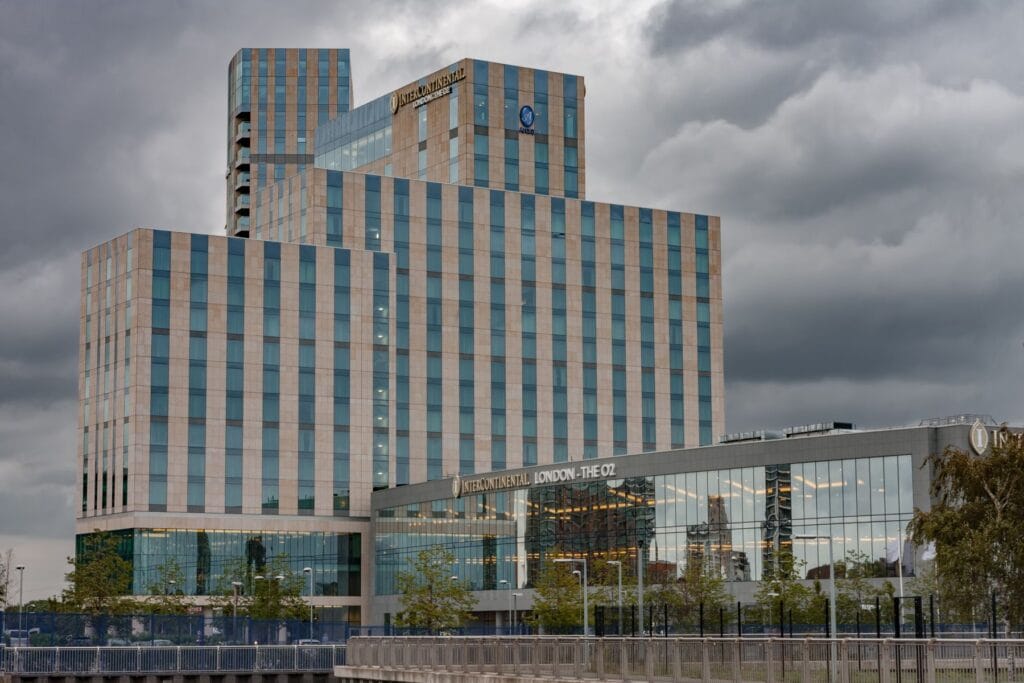
BIM software allows technicians to create highly detailed 3D models to detect and resolve potential problems long before installation starts and MultiCAD’s work on the Intercontinental Hotel, London provides an example where early clash detection was important. When rework is kept to a minimum, materials aren’t wasted and delays are prevented, both of which reduce embodied carbon.
Prefabrication of building elements
BIM supports the advanced workflows needed to co-ordinate seamlessly between on and off-site assembly, allowing prefabrication to happen at scale.
Off-site construction supports:
- lower emissions on site
- reduction of material waste
- quicker assembly and build process
- streamlined logistics (and lower emissions)
As an example, using precast hollowcore concrete slabs can reduce overall concrete use by nearly half and reduce associated energy consumption by nearly a third.
In summary, BIM allows early-clash detection, increased confidence in estimates of materials required and provides the accurate modelling needed to use prefabrication at scale.
3. More sustainable construction processes
Key benefits: BIM is more than a model, it’s a platform that organises data and streamlines communication about all aspects of the project. This supports better decision-making about how teams work together during design, build and beyond.
Digital workflows and remote collaboration
BIM supports matrix teams to collaborate remotely with ease. Designs can be shared digitally, removing the need to print documents, and specialists can collaborate from across the world, as needed.
Streamlined communication means better co-ordination between stakeholders, reducing misunderstandings and mistakes, which has a positive impact on sustainability.
4D BIM: scheduling and logistics
Going beyond 3D (or geometric data), 4D BIM is about scheduling data. This allows project managers to link information about materials, deliveries and where/when teams are needed on-site, directly with the 3D model.
Deliveries and personnel requirements can be planned with increasing accuracy to reduce emissions of transport and traffic. Real-time updates allow the plan to be modified as the project progresses and instantly communicated. More accurate scheduling improves logistics, optimises resources and increases safety on-site, delivering against sustainability, as well as all other KPIs.
Incorporating data on scheduling, logistics and workforce movement onsite means BIM gives an unparalleled view on the project.
Model the site, not just the building
With a terrain model of the site as part of your BIM, you can easily optimise things like crane positioning or the amount of excavation needed on-site, for example. With a clearer view of site constraints and requirements, overwork and re-work can be minimised and material staging will be more accurate, therefore reducing sustainability impacts.
In summary: Many small improvements across construction processes add up to a big sustainability impact. BIM supports with improving communication, scheduling, logistics, workforce movement and optimising the work for actual site requirements.
4. Sustainability throughout the building lifecycle
Key benefits: data-driven planning for carbon reduction throughout the decades of a building’s operation.
Energy efficiency in HVAC systems
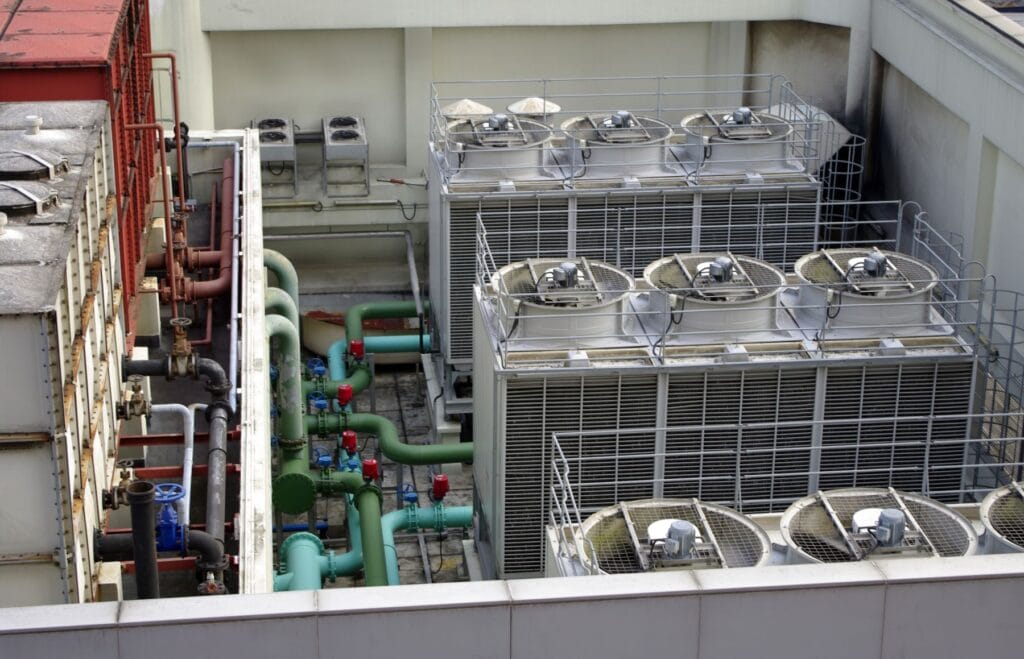
Accounting for 40% of a building’s energy use, HVAC systems are a major contributor to operating carbon. BIM can be used to evaluate potential HVAC performance, for example MultiCAD’s services include calculating duct sizes to estimate the heat load and create an accurate, digital simulation.
The team can identify opportunities to increase energy efficiency by optimising heat pumps, refrigerant flow, thermal insulation and ventilation equipment. Optimised choices at the design stage can lead to many years of efficiency gains, yielding significant sustainability benefits (not to mention energy cost savings).
Reducing water wastage
BIM allows specialist sub-contractors to easily model:
- Inclusion of low-flow toilets, sink fittings and shower heads to reduce water consumption.
- Systems to capture rainwater and treat greywater for reuse in irrigation and flushing toilets.
- Optimise pump systems and water heating to reduce water and energy consumption.
Creating a digital twin
The greatest power of BIM is its capacity to meaningfully categorise and integrate many dimensions of building data. Projects typically suffer from duplication of data, inconsistent and incompatible data sources and limitations on access to building condition and performance data.
A digital twin replicates the building and can be modelled at any stage of construction, including as-built and at any point post-handover, as long as relevant data is co-ordinated accurately.
The Vantage model, developed for University of Greenwich provides a digital twin of 115,000 square metres of estate. It demonstrates that incredibly complex estates can be modelled accurately, providing a single source model for space usage, building systems, building fabric, maintenance cycles, energy performance and climate risk, and allows multiple data sets to be queried at any given time.
In summary: the culmination of BIM and its multilayered data capabilities is having operational data on sustainability planning and performance available whenever it’s needed for.
BIM is your pathway to sustainability outcomes
Contact us to discuss how we’ll ensure your next project is successful and sustainable.